
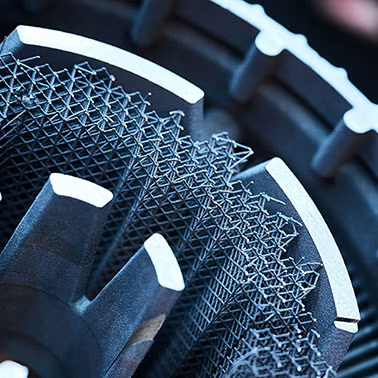
Powder metallurgy has long since evolved from a niche technology into an integral part of modern manufacturing processes. This fascinating and versatile manufacturing process has become indispensable in numerous industrial sectors. Whether in the automotive industry, medical technology, or aerospace—the production of components from metallic powders offers unique advantages over conventional casting or machining techniques
In this blog post, we take a practical look at the advantages of boron nitride in powder metallurgy: a concise overview for anyone seeking high-performance solutions in real-world applications.
Why is metal atomization gaining importance?
Today, metal atomization is one of the key processes for producing high-quality metal powders—especially when fine particle size, controlled properties, and reproducible quality are essential. The process is used whenever powdered metals are required, such as for sintering, additive manufacturing, or for complex high-performance materials like cemented carbides or magnetic alloys. Trends such as lightweight construction, customized components, and more efficient use of resources are also contributing to the growing number of companies turning to atomized metal powders. Not least due to the increasing use of metal 3D printing in industry.
A wide range of metals and alloys are used in this process: stainless steel, titanium, aluminum, nickel-based alloys, copper, cobalt-chromium, and even high-melting-point metals such as tungsten and molybdenum. Depending on the material and application, one may opt for gas atomization to produce particularly clean, spherical powder, or water atomization, which is more cost-effective but results in a coarser structure.
What matters most in this context?
First and foremost, a uniform particle size of the metal powder, a shape that is as spherical as possible to ensure good flow properties, and minimal oxidation—especially for reactive metals. The cooling rate also plays a role, as it influences the powder’s microstructure. Ultimately, one thing matters most for industrial applications: consistent quality in every batch.
Standard steel or iron powders do not pose significant challenges for metal atomization and can be processed using common nozzle materials such as zirconium dioxide. However, when it comes to specialty powders, quality requirements increase rapidly. Specific particle size distributions of the metal powders are required, or even the shape of the powder particles plays a decisive role. The quality of the powders is determined by narrow and consistent particle size distributions. These requirements must be reliably ensured and demand the highest precision during the atomization process.
In powder metallurgy, quality cannot be achieved without quantity. To operate the metal atomization process economically, the powder yield must be as high as possible and the scrap rate correspondingly low. Long downtimes or maintenance periods must be avoided, and the energy used must be utilized as efficiently as possible.
This is exactly where our HeBoSint® SL-N 300 comes into play.
HeBoSint® SL-N 300 is a boron nitride-silicon aluminum oxynitride composite ceramic specifically developed for contact with molten metals. This ceramic exhibits optimized wear resistance. Its excellent non-wetting properties prevent nozzle clogging and ensure a continuous process with uniform particle size of the metal powders, a long service life, and repeated use of the nozzle—batch after batch. The low thermal expansion of boron nitride in general ensures uniform powder particles.
Boron nitride is hot-pressed into a sintered body and then machined into precision components using standard machining methods. Conventional nozzles made of zirconia or alumina are typically machined in the green state and undergo sintering as a final step, which can lead to variations in component geometry. In particular, the tolerances of the nozzle bore—which is critical for atomization—can be kept significantly tighter with HeBoSint® SL-N 300. During the process itself, the precise nozzle and the low thermal expansion of boron nitride allow for targeted control over particle shape and distribution.
An additional advantage is the excellent thermal shock resistance of boron nitride ceramics. There is no need for extensive preheating of the nozzle, which reduces setup time and energy consumption. Using HeBoSint® SL-N 300 as the nozzle material can lower process costs while simultaneously improving quality.
Boron nitride nozzles:
- Nozzle durability during high-volume casting
- Chemical resistance to aggressive alloying elements
- Purity of the metal powder
- The particle size distribution (PSD) of the metal powder can be precisely controlled
- The shape of the particles can be precisely controlled
- Can be used without extensive preheating
- Highest yield
- Reduced litigation costs
- Reduced waste
- consistent quality in every batch
Conclusion and Outlook
With the growing use of additive manufacturing processes, the development of new alloys, and the increasing demand for customized, high-performance components, the importance of powder metallurgy will continue to grow. Materials such as HeBoSint® SL-N 300 will play a key role in making processes even more stable, economical, and precise. Further developments in material design and manufacturing technology could even expand the range of applications for boron nitride—for example, in the field of additive manufacturing or with particularly reactive melts.